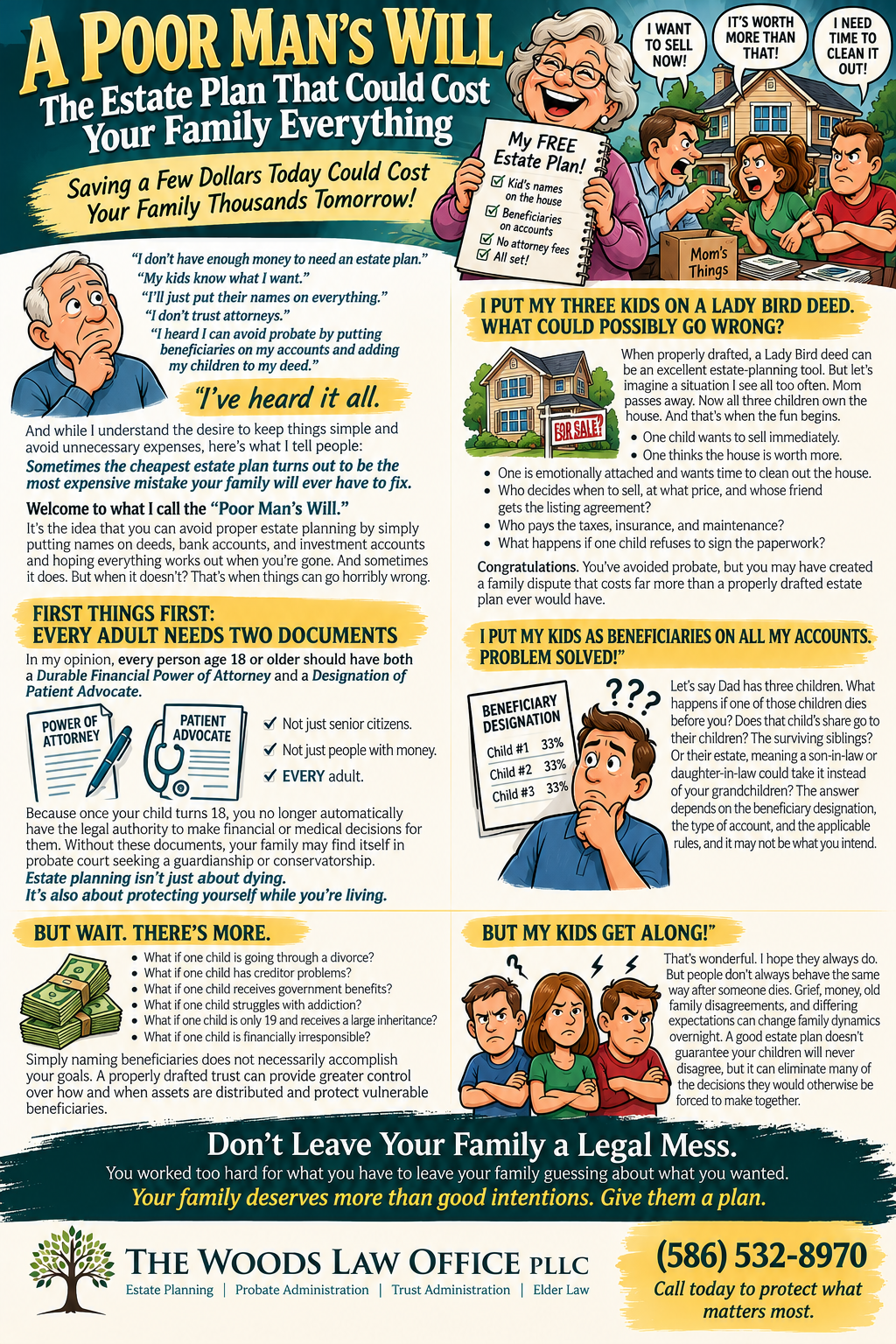
The Estate Plan That Could Cost Your Family Everything
Saving a Few Dollars Today Could Cost Your Family Thousands Tomorrow!
“I don’t have enough money to need an estate plan.”
“My kids know what I want.”
“I’ll just put their names on everything.”
“I don’t trust attorneys.”
“I heard I can avoid probate by putting beneficiaries on my accounts and adding my children to my deed.”
I’ve heard it all.
And while I understand the desire to keep things simple and avoid unnecessary expenses, here’s what I tell people:
Sometimes the cheapest estate plan turns out to be the most expensive mistake your family will ever have to fix.
Welcome to What I Call the “Poor Man’s Will.”
It’s the idea that you can avoid proper estate planning by simply putting names on deeds, bank accounts, and investment accounts and hoping everything works out when you’re gone.
And sometimes it does. But when it doesn’t? That’s when things can go horribly wrong.
First Things First: Every Adult Needs Two Documents
In my opinion, every person age 18 or older should have both a Durable Financial Power of Attorney and a Designation of Patient Advocate.
Not just senior citizens.
Not just people with money.
EVERY adult.
Because once your child turns 18, you no longer automatically have the legal authority to make financial or medical decisions for them. Without these documents, your family may find itself in probate court seeking a guardianship or conservatorship.
Estate planning isn’t just about dying. It’s also about protecting yourself while you’re living.
But Wait. There’s More.
What if one child is going through a divorce?
What if one child has creditor problems?
What if one child receives government benefits?
What if one child struggles with addiction?
What if one child is only 19 and receives a large inheritance?
What if one child is financially irresponsible?
Simply naming beneficiaries does not necessarily accomplish your goals. A properly drafted trust can provide greater control over how and when assets are distributed and protect vulnerable beneficiaries.
I Put My Three Kids on a Lady Bird Deed. What Could Possibly Go Wrong?
When properly drafted, a Lady Bird deed can be an excellent estate-planning tool. But let’s imagine a situation I see all too often.
Mom passes away. Now all three children own the house. And that’s when the fun begins.
- One child wants to sell immediately.
- One thinks the house is worth more.
- One is emotionally attached and wants time to clean out the house.
- Who decides when to sell, at what price, and whose friend gets the listing agreement?
- Who pays the taxes, insurance, and maintenance?
- What happens if one child refuses to sign the paperwork?
Congratulations. You’ve avoided probate, but you may have created a family dispute that costs far more than a properly drafted estate plan ever would have.
I Put My Kids as Beneficiaries on All My Accounts. Problem Solved!
Let’s say Dad has three children.
What happens if one of those children dies before Dad? Does that child’s share go to their children? The surviving siblings? Or their estate, meaning a son-in-law or daughter-in-law could take it instead of your grandchildren?
The answer depends on the beneficiary designation, the type of account, and the applicable rules, and it may not be what you intend.
But My Kids Get Along!
That’s wonderful. I hope they always do.
But people don’t always behave the same way after someone dies. Grief, money, old family disagreements, and differing expectations can change family dynamics overnight.
A good estate plan doesn’t guarantee your children will never disagree, but it can eliminate many of the decisions they would otherwise be forced to make together.
Don’t Leave Your Family a Legal Mess.
You worked too hard for what you have to leave your family guessing about what you wanted.
Your family deserves more than good intentions. Give them a plan.
Contact The Woods Law Office PLLC
Estate Planning | Probate Administration | Trust Administration | Elder Law
(586) 532-8970
Call today to protect what matters most.