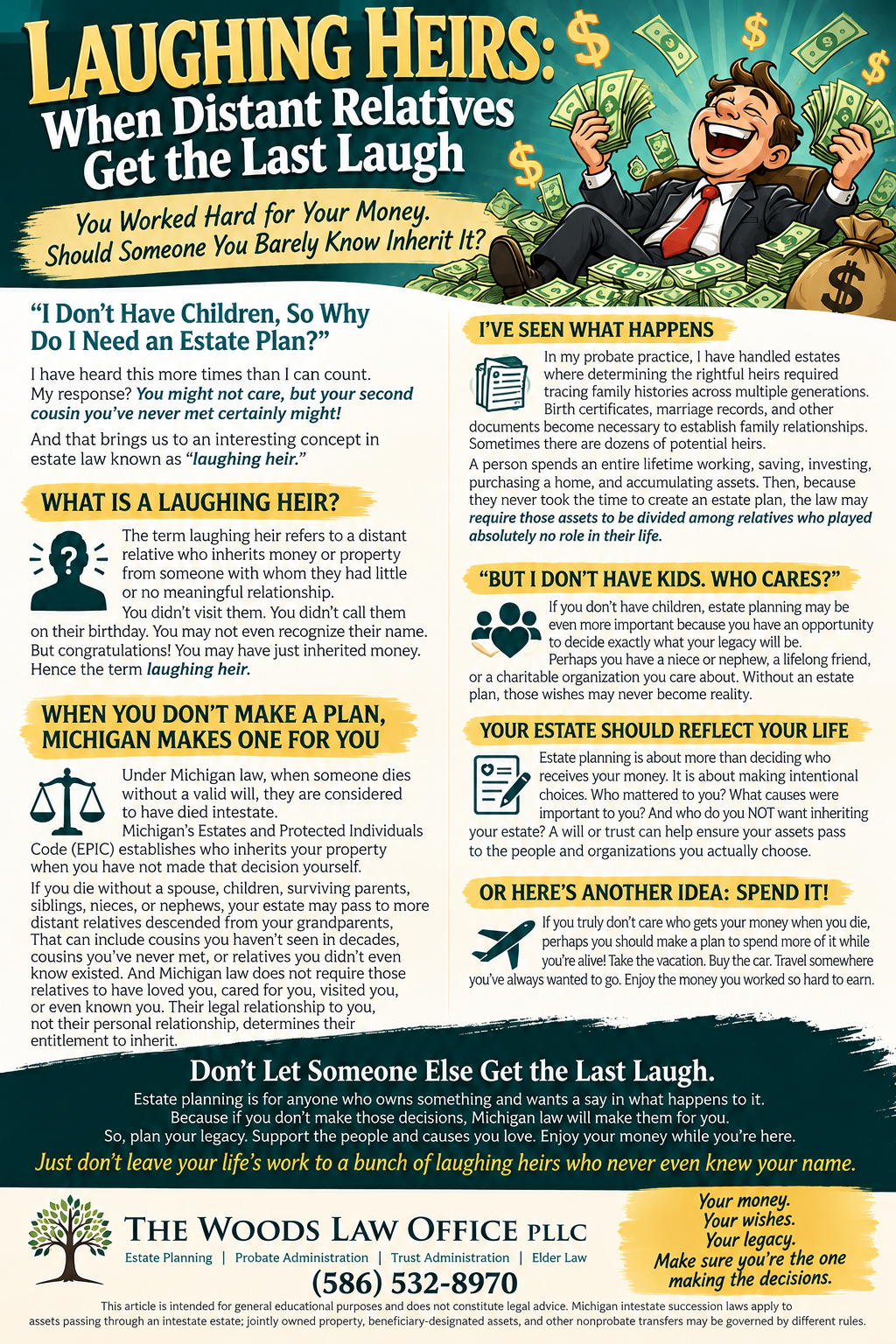
When Distant Relatives Get the Last Laugh
You Worked Hard for Your Money. Should Someone You Barely Know Inherit It?
“I Don’t Have Children, So Why Do I Need an Estate Plan?”
I have heard this more times than I can count.
My response? You might not care, but your second cousin you’ve never met certainly might!
And that brings us to an interesting concept in estate law known as a “laughing heir.”
What Is a Laughing Heir?
The term laughing heir refers to a distant relative who inherits money or property from someone with whom they had little or no meaningful relationship.
You didn’t visit them. You didn’t call them on their birthday. You may not even recognize their name.
But congratulations! You may have just inherited money.
Hence the term laughing heir.
When You Don’t Make a Plan, Michigan Makes One for You
Under Michigan law, when someone dies without a valid will, they are considered to have died intestate.
Michigan’s Estates and Protected Individuals Code (EPIC) establishes who inherits your property when you have not made that decision yourself.
If you die without a spouse, children, surviving parents, siblings, nieces, or nephews, your estate may pass to more distant relatives descended from your grandparents.
That can include cousins you haven’t seen in decades, cousins you’ve never met, or relatives you didn’t even know existed.
And Michigan law does not require those relatives to have loved you, cared for you, visited you, or even known you. Their legal relationship to you, not their personal relationship, determines their entitlement to inherit.
I’ve Seen What Happens
In my probate practice, I have handled estates where determining the rightful heirs required tracing family histories across multiple generations.
Birth certificates, marriage records, and other documents become necessary to establish family relationships. Sometimes there are dozens of potential heirs.
A person spends an entire lifetime working, saving, investing, purchasing a home, and accumulating assets. Then, because they never took the time to create an estate plan, the law may require those assets to be divided among relatives who played absolutely no role in their life.
“But I Don’t Have Kids. Who Cares?”
If you don’t have children, estate planning may be even more important because you have an opportunity to decide exactly what your legacy will be.
Perhaps you have a niece or nephew, a lifelong friend, or a charitable organization you care about.
Without an estate plan, those wishes may never become reality.
Your Estate Should Reflect Your Life
Estate planning is about more than deciding who receives your money.
It is about making intentional choices.
Who mattered to you? What causes were important to you? And who do you NOT want inheriting your estate?
A will or trust can help ensure your assets pass to the people and organizations you actually choose.
Or Here’s Another Idea: Spend It!
If you truly don’t care who gets your money when you die, perhaps you should make a plan to spend more of it while you’re alive!
Take the vacation. Buy the car. Travel somewhere you’ve always wanted to go.
Enjoy the money you worked so hard to earn.
Don’t Let Someone Else Get the Last Laugh.
Estate planning is for anyone who owns something and wants a say in what happens to it.
Because if you don’t make those decisions, Michigan law will make them for you.
So, plan your legacy. Support the people and causes you love. Enjoy your money while you’re here.
Just don’t leave your life’s work to a bunch of laughing heirs who never even knew your name.
The Woods Law Office PLLC
Estate Planning | Probate Administration | Trust Administration | Elder Law
(586) 532-8970
Your money. Your wishes. Your legacy.
Make sure you’re the one making the decisions.
This article is intended for general educational purposes and does not constitute legal advice. Michigan intestate succession laws apply to assets passing through an intestate estate; jointly owned property, beneficiary-designated assets, and other nonprobate transfers may be governed by different rules.