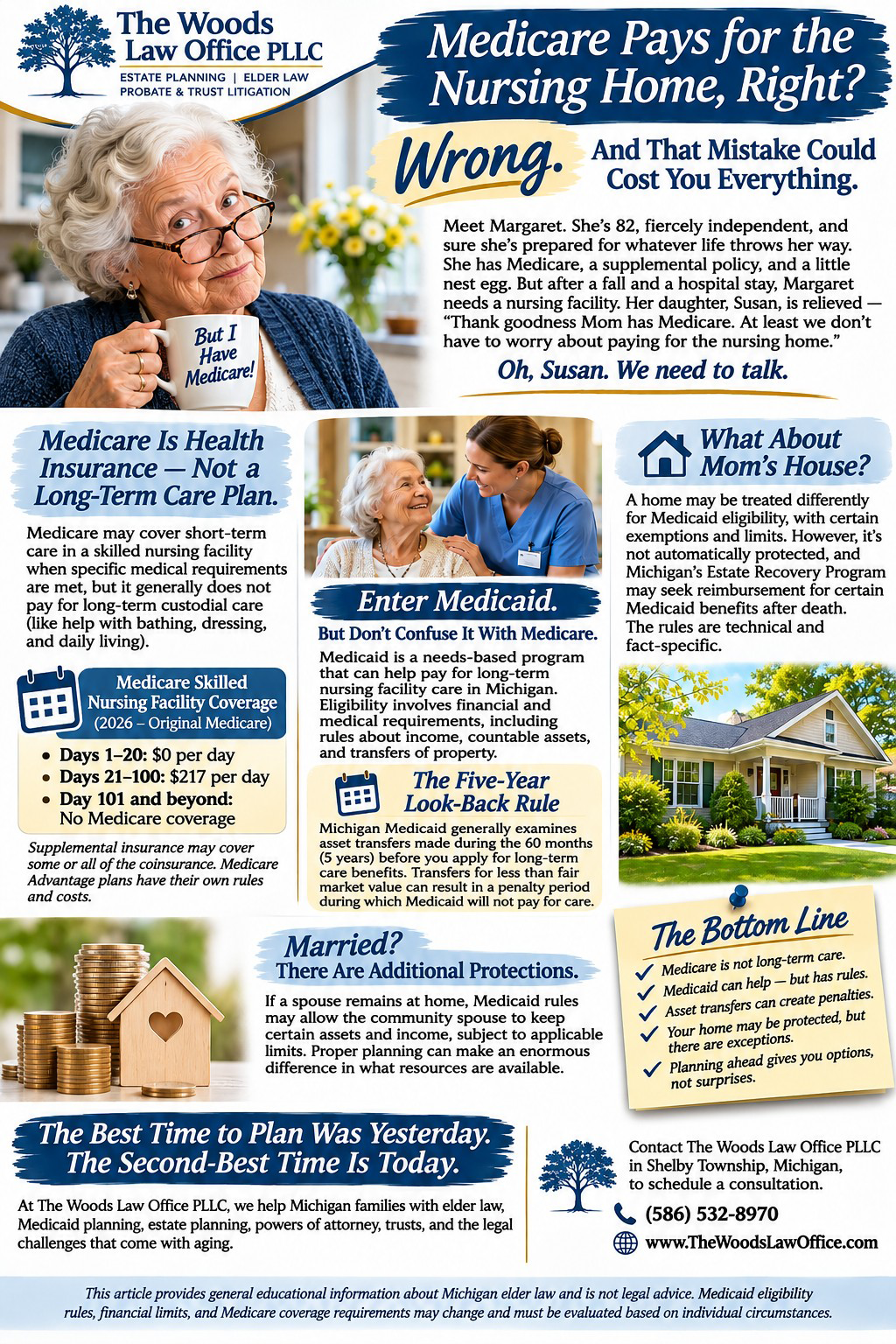
Understanding the difference between Medicare and Medicaid when planning for long-term nursing home care in Michigan.
Meet Margaret. She’s 82, fiercely independent, and sure she’s prepared for whatever life throws her way. She has Medicare, a supplemental insurance policy, and a little nest egg.
But after a fall and a hospital stay, Margaret needs a nursing facility. Her daughter, Susan, is relieved.
“Thank goodness Mom has Medicare. At least we don’t have to worry about paying for the nursing home.”
Unfortunately, Susan has made a common and potentially costly assumption.
Medicare is health insurance—not a long-term care plan.
Understanding what Medicare covers, how Medicaid works, and what happens to a family’s assets can make an enormous difference when a loved one needs ongoing care.
Does Medicare Pay for Nursing Home Care?
Medicare may cover short-term care in a skilled nursing facility when specific medical requirements are met. However, Medicare generally does not pay for long-term custodial care, including assistance with everyday activities such as bathing, dressing, eating, and living.
For 2026, Original Medicare’s skilled nursing facility coverage generally includes the following cost-sharing structure during a covered benefit period:
- Days 1–20: $0 per day.
- Days 21–100: $217 per day.
- Day 101 and beyond: No Medicare coverage for that skilled nursing facility stay.
These amounts apply only when Medicare’s coverage requirements are satisfied. A hospital stay does not automatically guarantee skilled nursing facility coverage.
Supplemental insurance may help cover some or all of the coinsurance. Medicare Advantage plans have their own coverage rules, networks, and costs.
The important distinction is that even when Medicare pays for rehabilitation or skilled nursing care, that coverage is limited. It is not designed to pay indefinitely for residential nursing home care.
What About Medicaid for Long-Term Nursing Home Care?
For Michigan residents who need ongoing nursing facility care, Medicaid may provide financial assistance.
Unlike Medicare, Medicaid is a needs-based program. Eligibility involves financial and medical requirements, including rules governing income, countable assets, and certain transfers of property.
A person who has Medicare may also qualify for Medicaid if they meet the applicable requirements.
However, qualifying for Medicaid is not simply a matter of spending down savings. The timing and manner in which assets are handled can affect eligibility, and decisions made without understanding the rules may create costly problems.
This is why Medicaid planning is an important part of elder law.
Understanding Michigan’s Five-Year Look-Back Rule
One of the most important Medicaid planning considerations is the five-year look-back period.
When someone applies for certain long-term care Medicaid benefits in Michigan, the state generally examines asset transfers made during the preceding 60 months.
Transfers made for less than fair market value may result in a penalty period during which Medicaid will not pay for certain long-term care services.
For example, giving money or property to family members shortly before applying for Medicaid may create eligibility complications rather than protecting those assets.
Not every transfer is treated the same way. Exceptions and special rules may apply depending on the circumstances.
The key takeaway: Transferring assets without a clear understanding of Medicaid rules can have serious financial consequences.
Will Medicaid Take Mom’s House?
For many families, the family home is their greatest financial concern.
A common question is whether a parent must sell their home to qualify for Medicaid or whether the home will be lost after their death.
The answer depends on several factors.
A home may receive different treatment under Medicaid eligibility rules, depending on circumstances such as ownership, residency, equity, and whether certain family members live there.
However, a home that is exempt for eligibility purposes is not necessarily protected from every future claim.
Michigan’s Estate Recovery Program may seek reimbursement for certain Medicaid benefits paid on behalf of eligible recipients after their death.
Estate recovery rules include limitations and exceptions, and the outcome can depend on the individual’s estate and family circumstances.
Families should not assume that their home is automatically protected—or that it must automatically be sold.
Married? There May Be Additional Protections
When one spouse needs nursing home care and the other remains at home, Medicaid rules include certain protections for the spouse living in the community.
These provisions may allow the community spouse to retain certain assets and income, subject to applicable limits.
The purpose is to help prevent the spouse remaining at home from becoming financially impoverished because the other spouse requires long-term care.
However, these rules are detailed, and the amount of income and assets that may be retained depends on the family’s circumstances.
Proper planning can make a significant difference in the financial resources available to both spouses.
Why Planning Ahead Matters
Families often begin researching nursing home costs and Medicaid eligibility only after a medical emergency.
A fall, hospitalization, or unexpected decline in health can quickly turn a family’s financial situation into a complicated legal matter.
By planning ahead, families can better understand:
- What Medicare will and will not cover.
- Whether Medicaid may help pay for long-term nursing facility care.
- How asset transfers may affect eligibility.
- What protections may apply to a family home.
- How Michigan estate recovery rules may affect an estate.
- What additional protections may be available for married couples.
Even when a loved one already needs nursing home care, it is worthwhile to seek legal guidance before making major financial decisions.
The Best Time to Plan Was Yesterday. The Second-Best Time Is Today.
At The Woods Law Office PLLC, we help Michigan families navigate the legal and financial challenges that come with aging.
Our services include elder law, Medicaid planning, estate planning, powers of attorney, trusts, probate, and related legal matters.
Whether you are planning for the future or facing an immediate long-term care decision, understanding your options is the first step toward protecting your family’s interests.
Contact The Woods Law Office PLLC in Shelby Township, Michigan, to schedule a consultation.
Phone: (586) 532-8970
Website: www.TheWoodsLawOffice.com
Disclaimer: This article provides general educational information about Michigan elder law and is not legal advice. Medicaid eligibility rules, financial limits, and Medicare coverage requirements may change and must be evaluated based on individual circumstances.