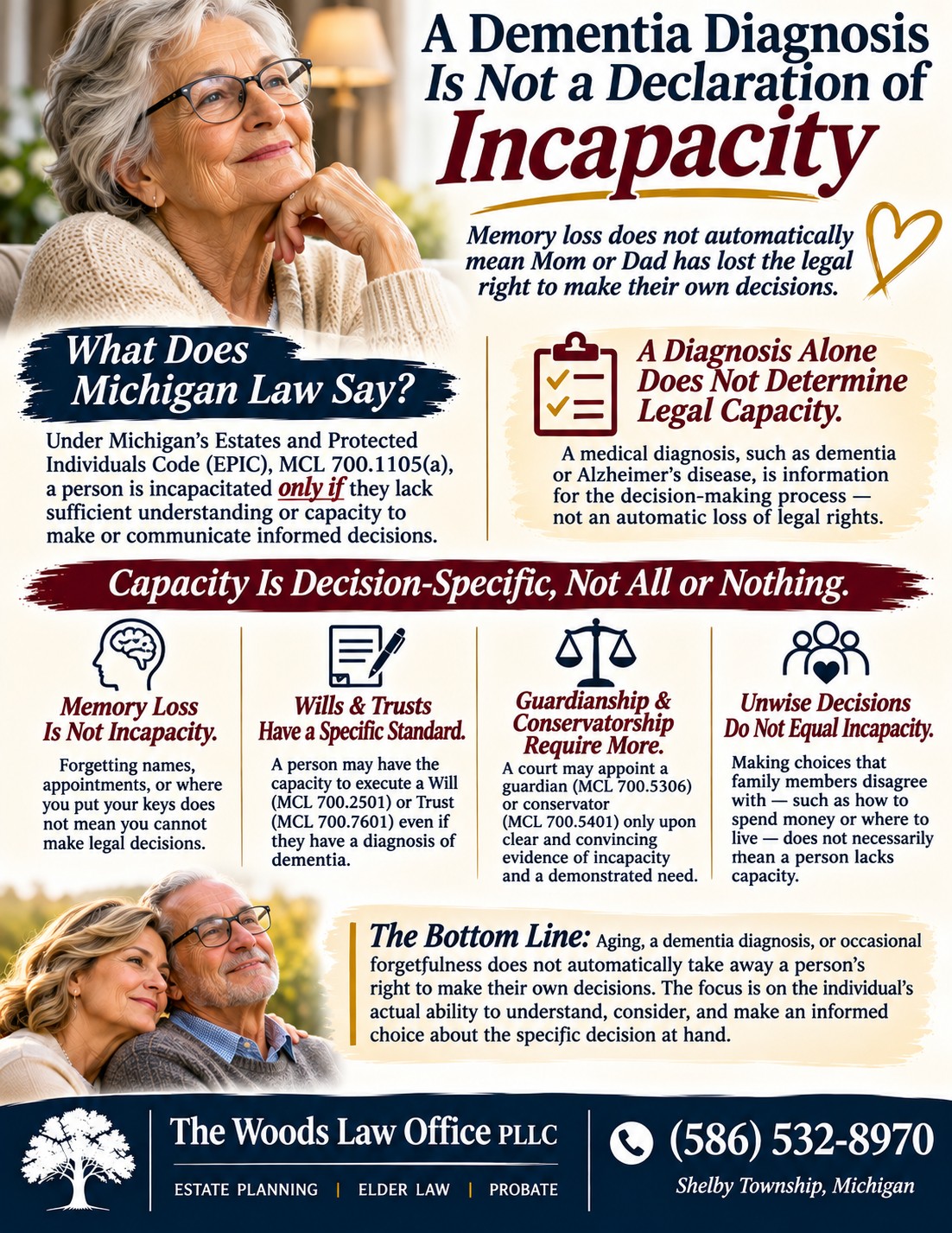
A diagnosis of dementia or Alzheimer’s disease does not automatically mean a person has lost the legal right to make their own decisions.
When a loved one is diagnosed with dementia, families often face difficult questions about their future. Can Mom still make her own medical decisions? Can Dad sign legal documents? Is it time to establish guardianship or conservatorship?
While these concerns are understandable, one important distinction is often overlooked: A medical diagnosis of dementia is not the same as a legal determination of incapacity.
Under Michigan law, a person’s ability to make decisions must be evaluated based on their actual understanding and abilities, not simply their age, diagnosis, or occasional forgetfulness.
What Does Michigan Law Say About Incapacity?
Michigan’s Estates and Protected Individuals Code (EPIC) provides the legal framework for determining when an individual may need assistance making important decisions.
Under MCL 700.1105(a), the definition of an incapacitated individual focuses on whether a person lacks sufficient understanding or capacity to make or communicate informed decisions.
This distinction is particularly important for individuals living with dementia.
A person may experience memory loss, confusion, or difficulty with certain activities while still retaining the ability to understand and make other important decisions.
A dementia diagnosis alone does not establish legal incapacity. Instead, the person’s individual circumstances and decision-making abilities must be considered.
Memory Loss Does Not Automatically Mean Incapacity
Forgetting appointments, misplacing keys, struggling to remember names, or occasionally repeating questions does not necessarily mean someone is incapable of making legal decisions.
Memory loss can affect individuals differently, and cognitive abilities may change over time.
For example, someone experiencing early-stage dementia may still be able to:
- Understand their financial circumstances and express preferences.
- Make informed decisions about medical treatment.
- Participate in estate planning discussions.
- Communicate their wishes regarding their care and living arrangements.
- Understand the consequences of certain legal decisions.
The important consideration is whether the individual understands the particular decision being made and its consequences.
Legal Capacity Is Decision-Specific
One of the most important concepts for Michigan families to understand is that legal capacity is not necessarily all or nothing.
A person may have sufficient capacity to make certain decisions while needing assistance with others.
Different legal decisions can also involve different standards of capacity.
Capacity to Make a Will or Trust
Michigan law establishes specific requirements for creating valid estate planning documents.
Under MCL 700.2501, an individual must meet certain requirements to execute a valid will, including having sufficient testamentary capacity.
Similarly, MCL 700.7601 addresses the capacity required to create, amend, revoke, or add property to a revocable trust.
A person with dementia may still meet the applicable legal standards, depending on their ability to understand the nature and consequences of the document at the time it is executed.
This is one reason families should not automatically assume that an Alzheimer’s or dementia diagnosis makes estate planning impossible.
Guardianship and Conservatorship Require More Than a Diagnosis
Families sometimes believe that a dementia diagnosis automatically means a guardian or conservator must be appointed.
However, Michigan law requires more than the existence of a medical condition.
Under MCL 700.5306, a court must consider the legal requirements for appointing a guardian, including evidence of incapacity and the need for guardianship.
Likewise, MCL 700.5401 addresses the circumstances under which a conservator may be appointed to manage an individual’s property or financial affairs.
These proceedings involve important legal protections because guardianship and conservatorship can affect a person’s independence and decision-making authority.
Courts must evaluate the individual’s actual needs rather than relying solely on a medical diagnosis.
Whenever appropriate, families should also consider whether less restrictive arrangements can provide the necessary support.
Making Decisions Others Disagree With Does Not Mean Someone Is Incapacitated
Another common misconception is that making an unusual, unpopular, or financially questionable decision automatically demonstrates incapacity.
For example, an older adult might choose to spend money in a way their children disagree with, remain in their longtime home, or decline a particular living arrangement.
Although family members may be concerned, disagreement with someone’s choices is not, by itself, proof that the person lacks legal capacity.
Adults generally retain the right to make their own decisions, even when others believe a different choice would be better.
The legal question focuses on whether the individual has the necessary ability to understand and make the decision—not whether family members approve of it.
Why Early Estate Planning Matters After a Dementia Diagnosis
Receiving a dementia diagnosis can make planning for the future especially important.
Rather than assuming it is too late to take action, families should consult an experienced Michigan elder law attorney to discuss which legal planning options may still be available.
Depending on the individual’s circumstances and legal capacity, these options may include:
- Durable Power of Attorney: Designating someone to handle financial matters when authorized.
- Patient Advocate Designation: Appointing a trusted individual to make healthcare decisions when the legal conditions for that authority are met.
- Wills and Trusts: Establishing or reviewing instructions for managing and distributing assets.
- Long-Term Care Planning: Preparing for potential care needs and associated expenses.
- Guardianship or Conservatorship: Exploring court involvement when necessary and when less restrictive alternatives are insufficient.
Planning early can help preserve an individual’s wishes, reduce uncertainty, and provide families with greater peace of mind.
The Bottom Line: A Diagnosis Does Not Eliminate Personal Rights
Aging, occasional forgetfulness, and even a dementia diagnosis do not automatically take away someone’s right to make decisions.
Michigan law recognizes the importance of evaluating a person’s actual abilities and the specific legal decision involved.
Someone may need help managing certain responsibilities while still retaining the ability to make meaningful choices about their life, healthcare, finances, and future.
The goal should be to protect vulnerable individuals while respecting their independence, dignity, and legal rights.
If your family is navigating a dementia diagnosis and has questions about estate planning, powers of attorney, guardianship, or conservatorship, experienced legal guidance can help clarify your options.
Contact The Woods Law Office PLLC
The Woods Law Office PLLC assists Michigan families with elder law, estate planning, probate, and related legal matters.
Whether you are planning ahead or facing questions about a loved one’s decision-making capacity, our office can help you understand the legal considerations and available options.
The Woods Law Office PLLC
Shelby Township, Michigan
Phone: (586) 532-8970
This article provides general information about Michigan law and is not a substitute for legal advice regarding an individual’s specific circumstances.