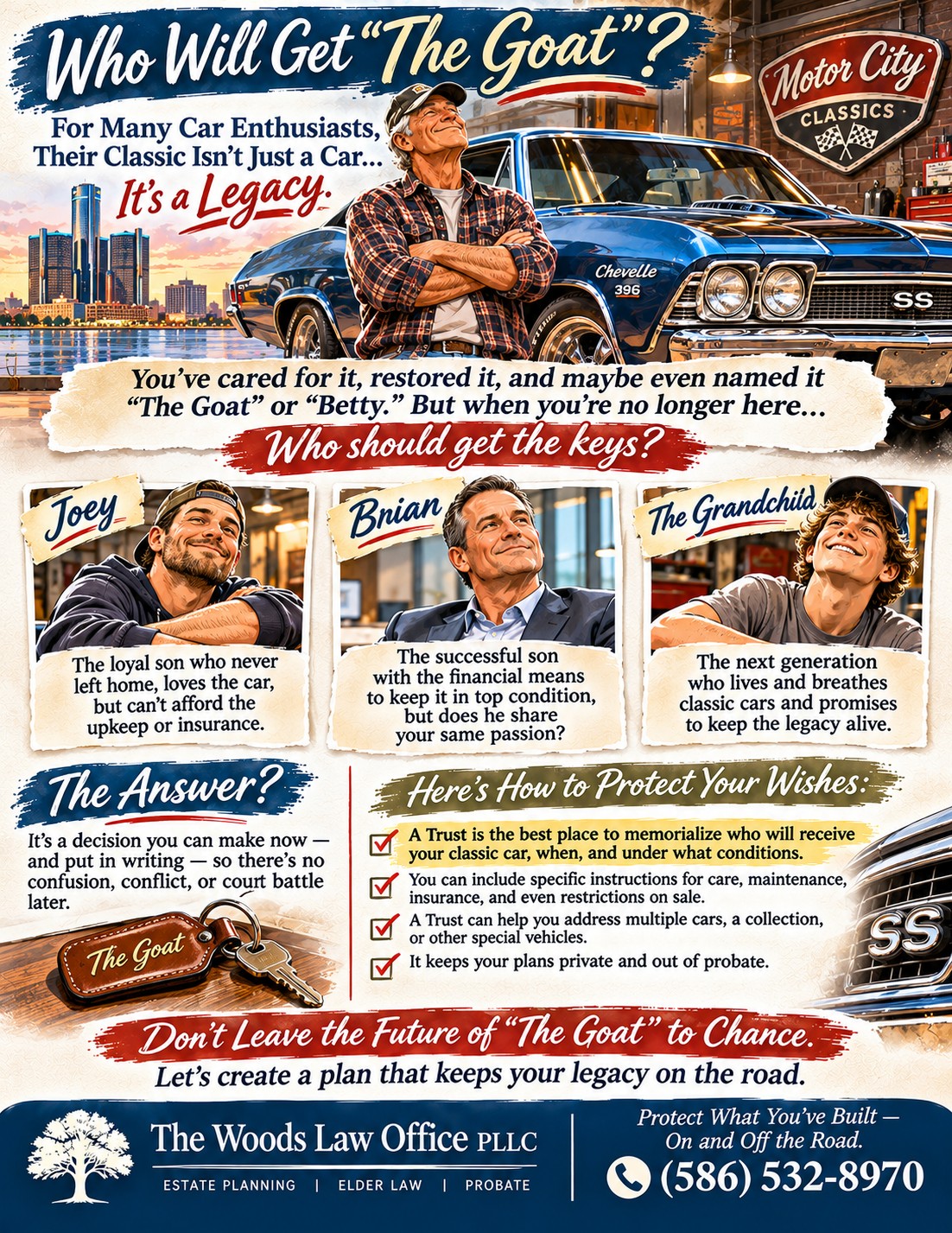
For many car enthusiasts, a classic car isn’t just a vehicle. It’s a legacy worth protecting.
You’ve spent years searching for the right parts, restoring the engine, polishing the chrome, and keeping your prized classic in showroom condition.
Maybe it’s a Chevrolet Chevelle SS, a Pontiac GTO affectionately nicknamed “The Goat,” or a vintage Mustang that’s been in your family for decades.
You’ve invested countless hours, significant money, and a whole lot of love into keeping that vehicle on the road.
But have you ever considered what will happen to your classic car when you’re no longer here?
Who will get the keys—and will they share your passion for preserving what you’ve built?
For Michigan classic car owners, estate planning is about more than passing along financial assets. It’s about protecting the vehicles, memories, and family traditions that make a collection special.
A Classic Car Is More Than Just an Asset
To an insurance company, a classic car may have a specific appraised value. To its owner, however, that same vehicle can be priceless.
Perhaps it was your first car, a restoration project shared with your father, or the muscle car you dreamed of owning as a teenager.
Every scratch, repair, and upgrade has a story.
And while your family may appreciate how much the vehicle means to you, they may have very different ideas about what should happen to it after your death.
Without clear estate planning instructions, your beloved classic could become the subject of disagreements, unexpected expenses, or even a forced sale.
The good news is that you can make these decisions now, while you’re still behind the wheel.
Who Should Inherit Your Classic Car?
Choosing who should receive a valuable or sentimental vehicle isn’t always easy.
Consider a family with three potential beneficiaries.
Joey: The Son Who Loves the Car but Can’t Afford It
Joey has always admired your classic car.
He grew up helping you wash it, attending car shows, and listening to stories about its restoration.
He would love to inherit it.
However, Joey may not have the financial resources to maintain the vehicle properly.
Classic cars often require specialized maintenance, secure storage, insurance, and occasional expensive repairs.
Leaving Joey the car without considering these expenses could create a financial burden.
An estate plan may help address this concern by coordinating the vehicle’s inheritance with other available assets or providing guidance about its ongoing care.
Brian: The Son Who Can Afford It but Doesn’t Share the Passion
Brian is financially successful.
He could easily afford the insurance, maintenance, and storage costs associated with the car.
But he doesn’t particularly enjoy classic vehicles.
To Brian, the Chevelle may simply be a valuable asset that could be sold.
If preserving the vehicle within the family is important to you, leaving it to someone based solely on their financial circumstances may not accomplish your wishes.
It’s worth having a conversation about whether Brian actually wants the car and what he would do with it.
The Grandchild: The Next Generation of Car Enthusiasts
Maybe your grandchild has inherited your love of classic automobiles.
They enjoy car shows, understand the importance of original parts, and dream of someday driving your prized vehicle.
Passing the car to a grandchild could keep your automotive legacy alive for another generation.
However, age, financial resources, driving experience, and the ability to maintain the vehicle should all be considered.
An estate plan can help address the timing and conditions of an inheritance when legally appropriate.
Why You Shouldn’t Leave the Decision to Your Family
It’s tempting to assume your family will work everything out after you’re gone.
Unfortunately, even close families can disagree about sentimental or valuable possessions.
One child may believe they were promised the car. Another may feel entitled to an equal share of its value. A third may want to sell it immediately.
These disagreements can become especially complicated when the vehicle has appreciated significantly or represents a substantial portion of the estate.
Without clear instructions, your personal representative or other authorized fiduciary may need to determine how the vehicle should be distributed under your estate documents and applicable Michigan law.
The best way to reduce confusion is to put your wishes in writing through a properly prepared estate plan.
How a Trust Can Help Protect Your Classic Car
A trust can be a valuable estate planning tool for Michigan residents who own classic cars, collectible vehicles, or significant automotive collections.
Depending on how it is structured, a trust can provide instructions about who should receive specific vehicles, when they should receive them, and how the assets should be managed.
1. Identify Who Will Receive the Vehicle
A properly drafted trust can identify the intended beneficiary of a particular vehicle.
For example, you may want your grandson to inherit your restored Pontiac GTO while another family member receives your Chevrolet Corvette.
Clearly identifying the vehicles and beneficiaries can help prevent misunderstandings.
It’s important to describe each vehicle accurately, including identifying information such as its year, make, model, and vehicle identification number (VIN).
2. Provide Instructions for Maintenance and Care
Classic cars require ongoing attention.
Your estate planning documents may include appropriate provisions addressing how a vehicle should be managed before distribution.
You may also wish to leave separate written guidance about:
- Maintenance schedules and preferred service providers.
- Storage requirements and seasonal care.
- Insurance coverage and appraisal information.
- Restoration records and original parts.
- Vehicle history and documentation.
Not every personal preference can or should become a legally enforceable trust restriction. An attorney can help distinguish between binding provisions and nonbinding guidance.
3. Address When the Vehicle Should Be Distributed
Sometimes the person you want to inherit a vehicle isn’t ready to take ownership immediately.
For example, a grandchild may be too young to drive or lack the resources to maintain the car.
A trust may allow for delayed distribution or management under specified conditions, depending on the trust’s terms and applicable law.
This can provide additional flexibility while helping you accomplish your long-term goals.
4. Plan for an Entire Collection
Some enthusiasts own more than one classic vehicle.
A collection may include restored muscle cars, vintage trucks, motorcycles, project vehicles, rare parts, and automotive memorabilia.
A trust can help organize how these assets should be managed and distributed.
It may also address whether particular vehicles should remain together, be distributed to different beneficiaries, or be sold under specified circumstances.
For valuable collections, professional appraisals and detailed inventories can make estate administration significantly easier.
Can a Trust Help Avoid Probate in Michigan?
One potential advantage of a properly funded revocable living trust is that assets held in the trust may pass according to its terms without going through probate.
This can simplify the transfer process and provide greater privacy than probate proceedings, which generally involve court records.
However, simply mentioning a classic car in a trust does not automatically place the vehicle into the trust.
Vehicle ownership and title arrangements must be coordinated with the estate plan.
Michigan has specific procedures for transferring vehicle titles, including transfers involving estates and trusts.
An estate planning attorney can help determine how the vehicle should be titled and what steps are necessary to implement your wishes.
What Happens if You Don’t Have an Estate Plan?
If you pass away without a valid will or other effective estate planning arrangement, Michigan’s intestate succession laws may determine who inherits property included in your probate estate.
These rules distribute property according to family relationships rather than personal preferences.
They do not necessarily account for which child helped restore the vehicle, who attended every car show, or who promised to preserve it.
Even when a will exists, disputes can arise if the document does not clearly address a valuable or sentimental automobile.
Michigan also provides certain vehicle transfer procedures that may apply outside ordinary probate administration in qualifying circumstances. Those procedures have specific requirements and should not be assumed to accomplish every owner’s wishes.
Planning ahead helps reduce the risk that your classic car’s future will be determined by uncertainty or family conflict.
Don’t Forget Insurance, Documentation, and Vehicle Value
A thoughtful plan should address more than who receives the keys.
Classic cars can carry substantial financial value, particularly when they are rare, professionally restored, or historically significant.
Owners should consider maintaining an updated inventory containing:
- Vehicle identification numbers and title information.
- Current photographs and appraisals.
- Insurance policies and coverage details.
- Restoration records and receipts.
- Information about outstanding loans or liens.
- Storage locations and access instructions.
- Contact information for trusted mechanics or restoration specialists.
This information can help your personal representative, trustee, or beneficiaries identify and protect the vehicles.
It may also reduce delays and confusion during estate administration.
What About Restrictions on Selling the Car?
Some classic car owners want to ensure that their vehicle remains in the family for generations.
They may wish to prohibit a beneficiary from selling it or require that the car be maintained in a particular condition.
While trusts can sometimes include conditions or restrictions, these provisions must be carefully drafted and evaluated under applicable law.
Not every restriction will be enforceable or practical.
For example, a beneficiary may face unexpected financial difficulties or become unable to store and maintain the vehicle.
An attorney can help you consider whether flexible instructions, alternative beneficiaries, or other planning arrangements would better accomplish your goals.
The objective should be to preserve your intentions without creating unnecessary complications for the people you care about.
Talk to Your Family Before You Hand Over the Keys
One of the most valuable estate planning steps doesn’t require a legal document.
It starts with a conversation.
Ask your children or grandchildren whether they actually want the vehicle.
Find out whether they understand the responsibilities of owning it.
Discuss what the car means to you and why preserving it matters.
You may discover that the family member you expected to inherit the car isn’t interested—or that someone else has quietly shared your enthusiasm for years.
These conversations can help you make informed decisions and reduce the potential for disagreements later.
Of course, verbal promises alone are not a substitute for a properly prepared estate plan.
Your wishes should be reflected in legally appropriate documents.
The Bottom Line: Don’t Leave the Future of “The Goat” to Chance
Your classic car represents years of hard work, dedication, memories, and personal pride.
Whether it’s a Pontiac GTO, a Chevrolet Chevelle, a vintage Mustang, or an entire collection of treasured automobiles, you deserve to decide what happens to it.
A thoughtfully prepared estate plan can help identify the right beneficiaries, address maintenance and financial concerns, provide appropriate instructions, and reduce the potential for future disputes.
You’ve spent years protecting your classic car. Now it’s time to protect its future.
Protect What You’ve Built—On and Off the Road
At The Woods Law Office PLLC, we help Michigan families create estate plans that reflect their personal wishes and protect the assets that matter most.
From family homes and financial accounts to classic cars and treasured collections, thoughtful planning can help ensure your legacy is handled according to your intentions.
Our office assists clients with estate planning, wills, trusts, elder law, and probate matters.
Whether you own one beloved classic or an entire collection, we can help you explore the legal options for passing it on to the next generation.
The Woods Law Office PLLC
Estate Planning | Elder Law | Probate
Shelby Township, Michigan
(586) 532-8970
Let’s create a plan that keeps your legacy on the road.
This article is provided for general informational purposes and does not constitute legal advice. Vehicle transfers, trust funding, beneficiary designations, and probate requirements depend on individual circumstances and applicable Michigan law.