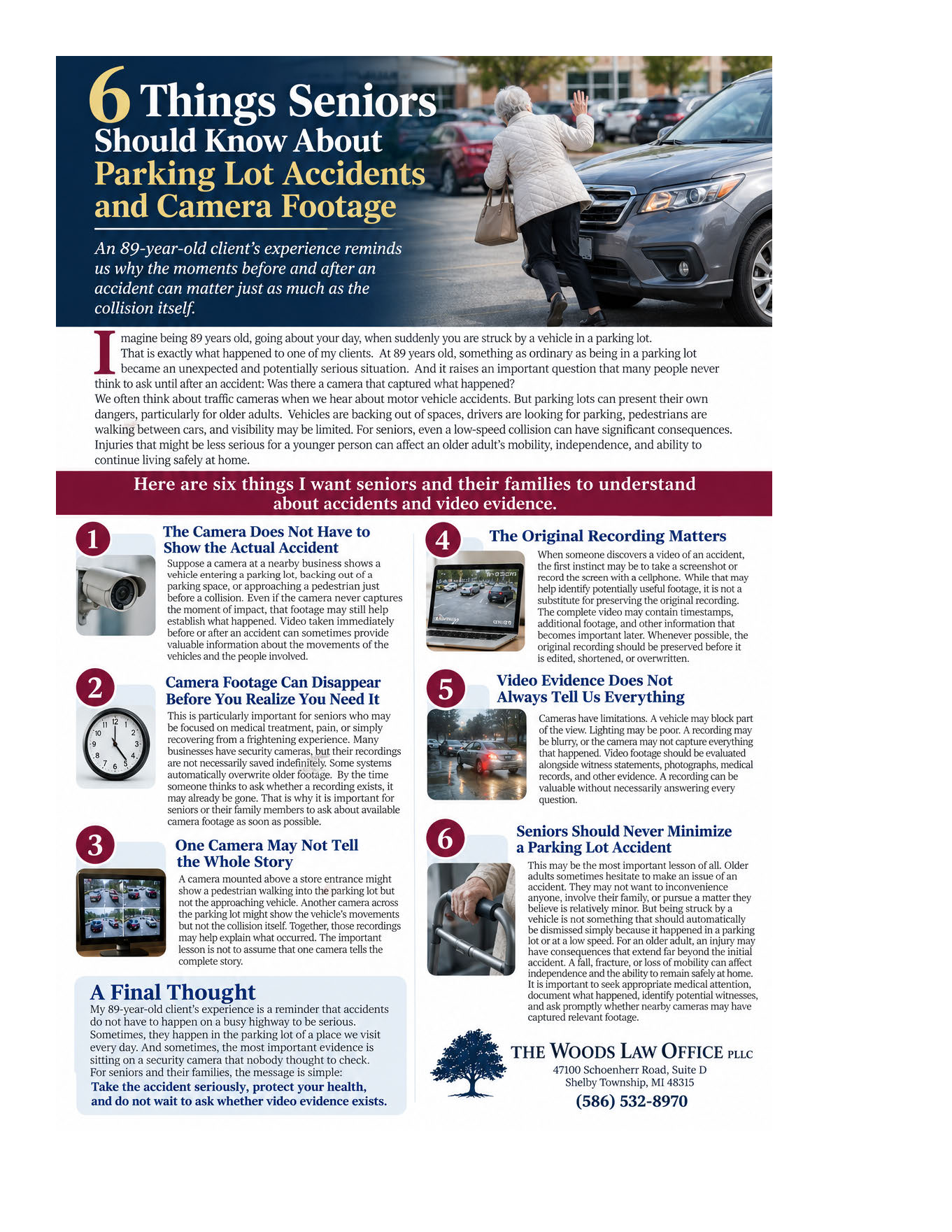
6 Things Seniors Should Know
An 89-year-old client’s experience reminds us why the moments before and after an accident can matter just as much as the collision itself.
Imagine being 89 years old, going about your day, when suddenly you are struck by a vehicle in a parking lot. That is exactly what happened to one of my clients. At 89 years old, something as ordinary as being in a parking lot became an unexpected and potentially serious situation. And it raises an important question that many people never think to ask until after an accident: Was there a camera that captured what happened?
We often think about traffic cameras when we hear about motor vehicle accidents. But parking lots can present their own dangers, particularly for older adults. Vehicles are backing out of spaces, drivers are looking for parking, pedestrians are walking between cars, and visibility may be limited. For seniors, even a low-speed collision can have significant consequences. Injuries that might be less serious for a younger person can affect an older adult’s mobility, independence, and ability to continue living safely at home.
Here are six things I want seniors and their families to understand about accidents and video evidence.
1. The Camera Does Not Have to Show the Actual Accident
Suppose a camera at a nearby business shows a vehicle entering a parking lot, backing out of a space, or approaching a pedestrian just before a collision. Even if the camera never captures the moment of impact, that footage may still help establish what happened. Video taken immediately before or after an accident can sometimes provide valuable information about the movements of the vehicles and the people involved.
2. Camera Footage Can Disappear Before You Realize You Need It
This is particularly important for seniors who may be focused on medical treatment, pain, or simply recovering from a frightening experience. Many businesses have security cameras, but their recordings are not necessarily saved indefinitely. Some systems automatically overwrite older footage. By the time someone thinks to ask whether a recording exists, it may already be gone.
That is why it is important for seniors or their family members to ask about available camera footage as soon as possible.
3. One Camera May Not Tell the Whole Story
A camera mounted above a store entrance might show a pedestrian walking into the parking lot but not the approaching vehicle. Another camera across the parking lot might show the vehicle’s movements but not the collision itself. Together, those recordings may help explain what occurred.
The important lesson is not to assume that one camera tells the complete story.
4. The Original Recording Matters
When someone discovers a video of an accident, the first instinct may be to take a screenshot or record the screen with a cellphone. While that may help identify potentially useful footage, it is not a substitute for preserving the original recording.
The complete video may contain timestamps, additional footage, and other information that becomes important later. Whenever possible, the original recording should be preserved before it is edited, shortened, or overwritten.
5. Video Evidence Does Not Always Tell Us Everything
Cameras have limitations. A vehicle may block part of the view. Lighting may be poor. A recording may be blurry, or the camera may not capture everything that happened. Video footage should be evaluated alongside witness statements, photographs, medical records, and other evidence. A recording can be valuable without necessarily answering every question.
6. Seniors Should Never Minimize a Parking Lot Accident
This may be the most important lesson of all. Older adults sometimes hesitate to make an issue of an accident. They may not want to inconvenience anyone, involve their family, or pursue a matter they believe is relatively minor. But being struck by a vehicle is not something that should automatically be dismissed simply because it happened in a parking lot or at a low speed.
For an older adult, an injury may have consequences that extend far beyond the initial accident. A fall, fracture, or loss of mobility can affect independence and the ability to remain safely at home.
It is important to seek appropriate medical attention, document what happened, identify potential witnesses, and ask promptly whether nearby cameras may have captured relevant footage.
A Final Thought
My 89-year-old client’s experience is a reminder that accidents do not have to happen on a busy highway to be serious. Sometimes, they happen in the parking lot of a place we visit every day. And sometimes, the most important evidence is sitting on a security camera that nobody thought to check.
For seniors and their families, the message is simple:
Take the accident seriously, protect your health, and do not wait to ask whether video evidence exists.
THE WOODS LAW OFFICE PLLC
47100 Schoenherr Road, Suite D
Shelby Township, MI 48315
(586) 532-8970