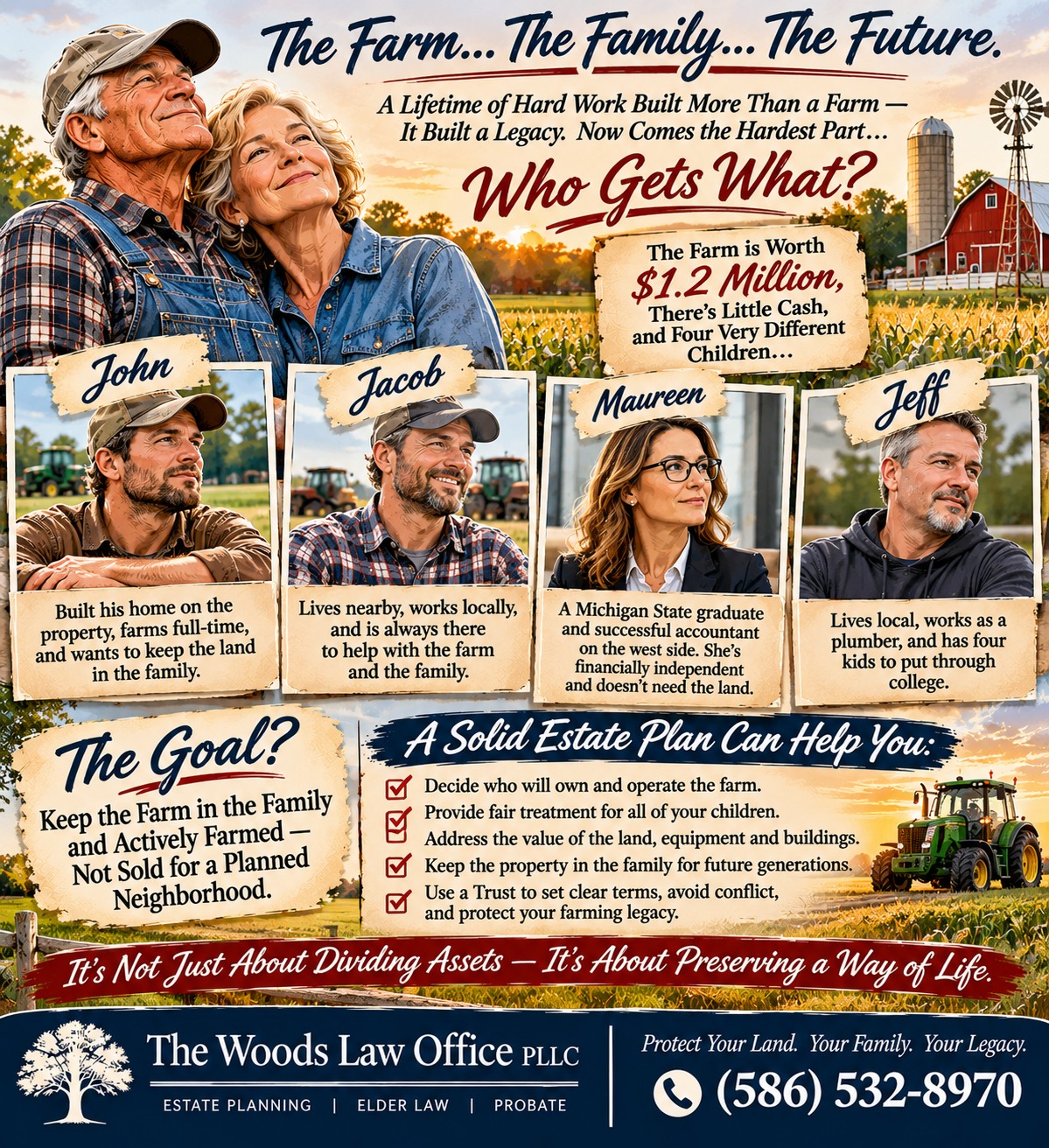
A lifetime of hard work built more than a farm. It built a legacy. Now comes one of the hardest decisions: Who gets what?
For many Michigan farming families, the family farm represents generations of hard work, sacrifice, and tradition.
It’s where children grew up learning the value of an honest day’s work, where parents spent countless hours tending fields and maintaining equipment, and where family memories were made around the kitchen table.
But eventually, every farming family faces an important question:
What happens to the farm when Mom and Dad are no longer here?
The answer isn’t always simple, especially when children have different interests, financial circumstances, and expectations.
A thoughtfully prepared estate plan can help protect the land, provide fair treatment for family members, and preserve the farming legacy for future generations.
When the Farm Is Valuable but Cash Is Limited
Consider a Michigan farming family that owns property, equipment, and buildings valued at approximately $1.2 million.
On paper, the family has substantial assets.
However, much of that wealth is tied up in farmland, machinery, and structures rather than readily available cash.
This creates a common estate planning challenge.
How do parents divide their estate fairly among their children without forcing the sale of the farm?
Dividing everything equally may sound reasonable, but an equal division of ownership does not always produce a practical outcome.
If one child wants to continue farming while others would prefer to receive their inheritance in cash, disagreements can quickly develop.
Without proper planning, the family may eventually face difficult decisions about selling land, dividing property, or financing a buyout.
The goal of farm estate planning is to address these issues before they become family conflicts.
Four Children, Four Very Different Circumstances
Imagine a family with four adult children.
Each has a different relationship with the farm, and each brings different needs and expectations to the conversation.
John: The Son Who Farms the Land
John built his home on the family property and works the farm full-time.
He has dedicated years to maintaining the fields, caring for equipment, and helping the operation succeed.
For John, the farm is more than an inheritance. It’s his livelihood and his home.
He wants the property to remain in the family and continue operating as a working farm.
However, if the farm is divided equally among all four children, John may not have the financial resources to purchase his siblings’ shares.
Without a clear succession plan, the person most committed to continuing the operation could face the possibility of losing the land.
Jacob: The Son Who Is Always There to Help
Jacob lives nearby, works locally, and regularly helps with farm responsibilities.
He may not depend on the farm for his primary income, but he has contributed time and effort over the years.
Should his involvement be recognized in the estate plan?
Would he prefer partial ownership, financial compensation, or another arrangement?
These questions deserve consideration, particularly when parents want to acknowledge contributions without creating disagreements among siblings.
Maureen: The Financially Independent Daughter
Maureen is a successful accountant who lives on the west side of Michigan.
She has established her own career and does not need the farm for financial support.
Although she values her family’s history, she may have little interest in owning or managing agricultural property.
Would she prefer a financial inheritance instead of a share of the farmland?
Could other estate assets provide an appropriate distribution?
Understanding her wishes may help the family develop a more practical plan.
Jeff: The Son With Other Financial Responsibilities
Jeff lives locally, works as a plumber, and has four children to put through college.
He loves his family and appreciates the farm, but his financial priorities are different.
Receiving an ownership interest in farmland might provide long-term value, but it may not help with immediate expenses.
He could prefer an inheritance that offers greater financial flexibility.
This creates another challenge: how can parents treat Jeff fairly while keeping the farm intact?
Equal Doesn’t Always Mean Fair
One of the most important discussions in farm estate planning involves the difference between equal and equitable treatment.
An equal distribution might give each of four children a 25% ownership interest in the farm.
However, this arrangement can create practical problems.
What happens if one sibling wants to sell while another wants to continue farming?
Who pays property taxes, maintenance expenses, and insurance?
Who makes decisions about equipment purchases, leasing arrangements, or future improvements?
Could disagreements eventually result in pressure to sell the property?
For families hoping to preserve a working farm, shared ownership without a clear management plan can create complications.
Fair estate planning considers the needs of the entire family while recognizing the unique responsibilities of those who actively operate the farm.
This does not necessarily mean every child must receive the same assets.
Instead, parents can work with an estate planning attorney to explore distributions that reflect their priorities, available resources, and family circumstances.
How a Trust Can Help Protect the Family Farm
A properly drafted trust can be an important tool for families who want to preserve farmland and provide clear instructions for future generations.
Depending on the family’s circumstances, a trust may help address ownership, management, distribution, and succession issues.
1. Decide Who Will Own and Operate the Farm
A trust may identify who should ultimately receive the farmland and establish appropriate instructions for managing it.
For example, parents may wish to provide an opportunity for the child actively farming the property to continue operating it.
The trust could also address how ownership interests are distributed and what happens if the intended successor is unable or unwilling to continue farming.
Clear instructions can help reduce uncertainty after the parents’ deaths.
2. Provide Fair Treatment for All Children
A thoughtful estate plan can consider ways to provide for children who do not want to participate in the farming operation.
Depending on the estate’s assets and financial circumstances, options may include distributing other property, providing cash inheritances, using life insurance proceeds, or establishing structured buyout arrangements.
Not every option is appropriate for every family.
For example, a buyout arrangement must account for whether the farming operation can realistically support the required payments.
The goal is to avoid creating financial obligations that threaten the farm’s continued operation.
3. Address Land, Equipment, and Buildings
A farm often includes several different types of assets.
These may include:
- Agricultural land and additional acreage.
- Residential property and farmhouses.
- Barns, silos, and storage buildings.
- Tractors, combines, and other machinery.
- Livestock and agricultural inventory.
- Business interests and operating accounts.
Each asset may require different planning considerations.
For example, farmland ownership may be separate from the business entity operating the farm.
A comprehensive estate plan should account for these distinctions and coordinate with existing deeds, business agreements, and ownership arrangements.
4. Establish Terms for Future Ownership
Parents may want the land to remain in the family rather than eventually being sold for residential or commercial development.
A trust may provide certain instructions or conditions intended to support that goal.
However, restrictions on property ownership and sale must be carefully evaluated for legal enforceability and practicality.
Future generations may face circumstances that are difficult to predict today.
An attorney can help families consider provisions that protect their intentions while allowing appropriate flexibility.
5. Reduce Conflict and Potential Probate Complications
When properly established and funded, a revocable living trust may allow certain assets to transfer outside probate.
This can simplify estate administration and provide greater privacy.
However, creating a trust alone does not automatically transfer farmland or other assets into it.
Property titles, deeds, business ownership interests, and beneficiary arrangements must be coordinated with the overall estate plan.
Without appropriate funding and documentation, some assets may still require probate or other legal proceedings.
What Happens Without a Farm Succession Plan?
Without a clear estate plan, families may face difficult questions about ownership, management, and inheritance.
If property passes to multiple heirs, those individuals may have different opinions about its future.
One may want to continue farming.
Another may want to sell.
A third may prefer to lease the land.
These differences can create financial and emotional pressure, especially when the farm represents the family’s primary asset.
In some situations, disputes over jointly owned property can lead to litigation or requests for partition, potentially threatening the family’s goal of keeping the land together.
Michigan’s inheritance laws may also determine how property passes when someone dies without an effective estate plan.
Those laws do not necessarily reflect the owner’s personal wishes or recognize which family members have spent years working the land.
Planning ahead gives parents an opportunity to make these decisions themselves.
Consider the Financial Realities of Keeping the Farm
Preserving a farm requires more than deciding who inherits the property.
Families should also consider whether the next generation can afford to maintain and operate it.
Important questions include:
Property expenses: Who will pay taxes, insurance, maintenance, and necessary improvements?
Equipment costs: Will the farming operation have sufficient resources to repair or replace machinery?
Existing debt: Are there mortgages, operating loans, equipment financing arrangements, or other obligations?
Income: Can the farm generate enough revenue to support continued operations?
Buyout arrangements: If one child receives the farm, can that child realistically compensate other beneficiaries under the proposed plan?
Taxes: Could estate, income, capital gains, or property tax considerations affect the transfer?
Because agricultural operations can involve complicated financial and tax issues, estate planning should be coordinated with appropriate accounting and agricultural business professionals when necessary.
What About Farmland That Developers Want to Purchase?
As Michigan communities grow, agricultural land can become attractive to developers.
A property that has been farmed for generations may eventually be worth substantially more for residential or commercial development.
This can create difficult choices for heirs.
Some family members may see an opportunity for a significant financial return.
Others may want to preserve the land’s agricultural use.
Families who feel strongly about keeping their property in farming should discuss those goals during the estate planning process.
Depending on the circumstances, planning may involve trust provisions, business succession arrangements, or consideration of land preservation tools such as agricultural conservation easements.
Each approach has legal, financial, and practical implications.
If keeping the farm in agricultural use is your priority, that goal should be clearly communicated and incorporated into an appropriate long-term plan.
Why Family Conversations Matter
One of the most valuable steps in farm succession planning is also one of the most difficult: talking openly with your children.
Parents may assume they know which child wants the farm.
But those assumptions are not always correct.
A child who helps occasionally may not want the responsibility of ownership.
Another who lives farther away may be interested in preserving the property.
And the child currently operating the farm may have concerns about debt, equipment costs, or buying out siblings.
Honest conversations can help clarify expectations before legal documents are prepared.
Although parents ultimately decide how to distribute their assets, understanding their children’s goals can help create a more workable plan.
It may also reduce the likelihood of resentment and conflict after the parents are gone.
Review Your Estate Plan as Circumstances Change
Farming families experience changes just like every other family.
Children marry, grandchildren arrive, property values increase, and farming operations evolve.
A succession plan that made sense ten years ago may no longer reflect the family’s needs.
Important events that may justify reviewing an estate plan include:
- Changes in farmland value or ownership.
- Retirement from active farming.
- A child joining or leaving the farming operation.
- The purchase or sale of agricultural property.
- Changes in family relationships.
- Significant changes in debt or business structure.
- The death or incapacity of a named successor or fiduciary.
Periodic reviews can help ensure the plan continues to support the family’s goals.
The Bottom Line: It’s About Preserving a Way of Life
A family farm is more than land, buildings, and equipment.
It represents early mornings, long harvest seasons, generations of memories, and years of dedication.
For many Michigan families, the ultimate goal isn’t simply to divide the estate equally.
It’s to keep the farm in the family, preserve its agricultural purpose, and provide fair treatment for the people they love.
A thoughtfully prepared estate plan can help address ownership, succession, financial responsibilities, and future management before difficult decisions arise.
By planning today, families can take meaningful steps toward protecting the land and the legacy they’ve worked so hard to build.
Protect Your Land. Your Family. Your Legacy.
At The Woods Law Office PLLC, we understand that estate planning involves more than deciding who receives property.
For Michigan farming families, it can mean preserving generations of hard work while preparing for the future.
Our office assists clients with estate planning, wills, trusts, elder law, and probate matters.
Whether your family owns a small farm or a substantial agricultural property, thoughtful planning can help you explore ways to protect your wishes and reduce potential complications for future generations.
The Woods Law Office PLLC
Estate Planning | Elder Law | Probate
Shelby Township, Michigan
(586) 532-8970
It’s not just about dividing assets. It’s about preserving a way of life.
This article is intended for general informational purposes and does not constitute legal advice. Farm succession, trust funding, property transfers, tax planning, and business ownership arrangements should be evaluated based on individual circumstances and applicable Michigan law.