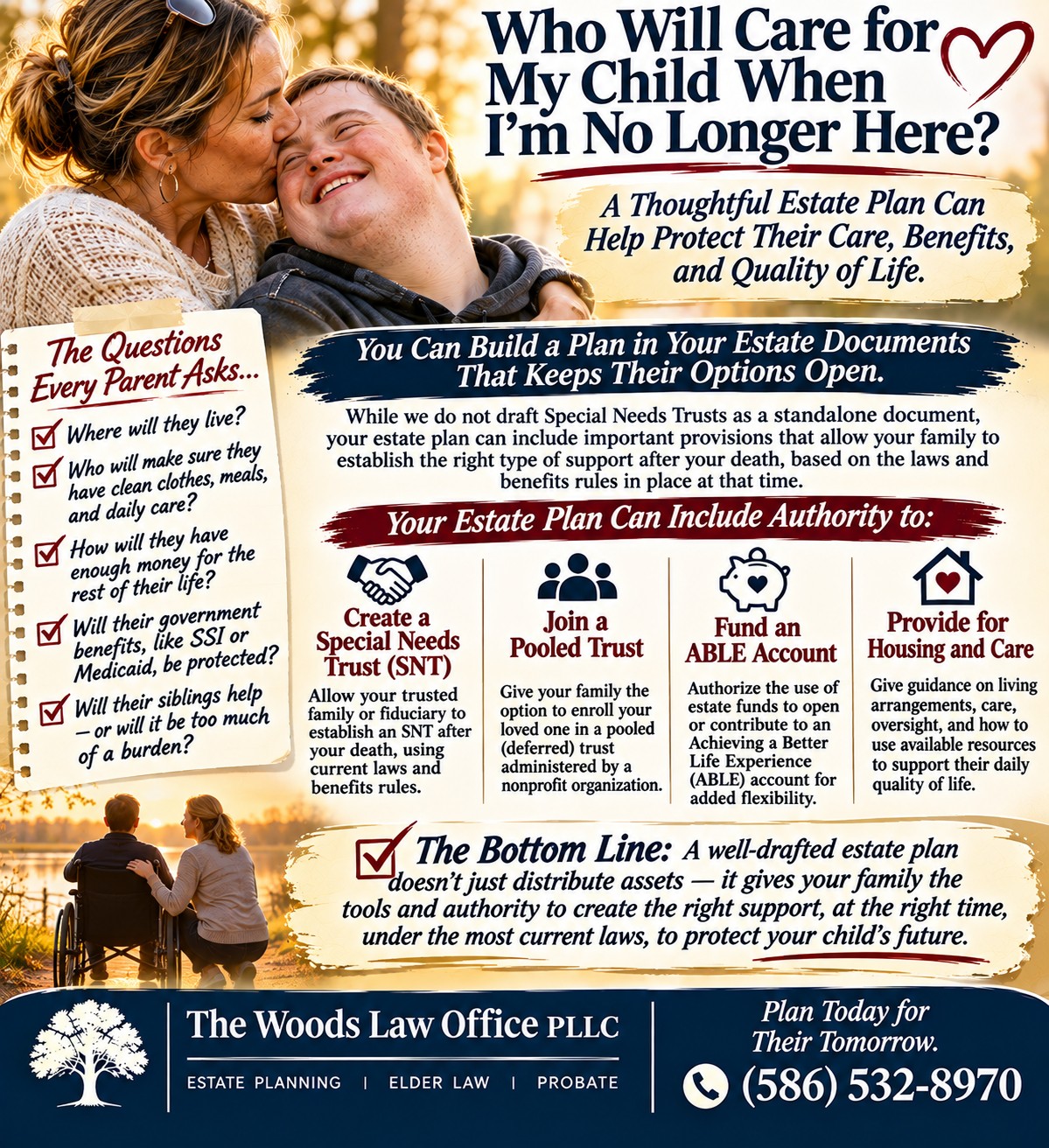
A thoughtful estate plan can help protect your child’s care, government benefits, financial security, and quality of life long after you’re gone.
For parents of children with disabilities or special needs, one of the most emotional questions about the future is also one of the most important:
“Who will take care of my child when I’m no longer here?”
It’s a question that goes far beyond money or inheritance. Parents worry about where their child will live, who will make sure their daily needs are met, whether government benefits will continue, and who will advocate for their well-being.
These concerns don’t disappear when a child becomes an adult. In fact, for many families, planning becomes even more important as parents grow older.
Fortunately, a thoughtfully prepared estate plan can provide families with options, guidance, and legal authority to establish appropriate support when it’s needed.
At The Woods Law Office PLLC, we help Michigan families understand how estate planning can create a foundation for protecting their loved ones’ futures.
The Questions Every Parent Asks
Parents who care for a child with special needs often spend years coordinating medical appointments, managing finances, arranging transportation, and advocating for services.
But what happens when they are no longer able to provide that support?
Some of the most common concerns include:
- Where will my child live? Will they remain in their current home, live with family, or need a supported living arrangement?
- Who will provide daily care? Who will make sure they have meals, clean clothing, transportation, and appropriate medical attention?
- How will they be financially supported? Will there be enough money to supplement their needs throughout their lifetime?
- Will government benefits be protected? Could an inheritance affect eligibility for Supplemental Security Income (SSI) or Medicaid?
- Will siblings be expected to take over? How can responsibilities be shared without creating an overwhelming burden?
These questions are deeply personal, and the answers will differ from family to family.
The important thing is to begin planning before a crisis occurs.
Why Traditional Estate Planning May Not Be Enough
Many parents assume that leaving money directly to their child through a will is the best way to provide financial security.
However, for a person who receives means-tested government benefits, a direct inheritance can create unintended consequences.
Programs such as SSI and certain Medicaid benefits have financial eligibility requirements. Depending on the circumstances, receiving assets outright may affect eligibility.
A traditional inheritance may also create challenges if the beneficiary needs assistance managing money or making financial decisions.
The goal of thoughtful estate planning is not simply to leave assets behind. It’s to help ensure those assets can be used appropriately while considering the individual’s long-term care needs and benefit eligibility.
This is why families should discuss available planning options with an attorney familiar with Michigan estate planning and the issues affecting individuals with disabilities.
Building Flexibility Into Your Estate Plan
One important consideration is that laws, government benefit requirements, and family circumstances can change over time.
An estate plan created today may not be implemented until many years in the future.
For that reason, flexibility can be especially valuable.
Rather than assuming one specific arrangement will always be appropriate, an estate plan may include provisions that give trusted individuals the authority to evaluate available options and establish appropriate support after a parent’s death.
At The Woods Law Office PLLC, we do not draft special needs trusts as standalone documents. However, estate planning documents may include provisions designed to give family members or fiduciaries the ability to consider and establish appropriate arrangements when needed, subject to applicable law and the terms of the documents.
This approach can help families plan for future circumstances without assuming that today’s benefit rules or care arrangements will remain unchanged.
Four Important Planning Options to Consider
Depending on the family’s circumstances, an estate plan may address several ways to provide financial and practical support.
1. Establishing a Special Needs Trust
A special needs trust (SNT) is a legal arrangement that may allow assets to be used for the benefit of a person with disabilities while helping preserve eligibility for certain means-tested government programs when properly structured and administered.
Rather than distributing an inheritance directly to the beneficiary, assets may be managed by a trustee who follows the trust’s terms and applicable legal requirements.
A special needs trust may help provide supplemental support for expenses such as personal care, transportation, recreation, education, and other needs.
However, not every trust qualifies for favorable treatment under SSI or Medicaid rules. The source of the funds, the trust’s provisions, and how distributions are made can all affect benefit eligibility.
Families should obtain specialized legal guidance before establishing or funding a special needs trust.
An estate plan may include provisions allowing an appropriate trust arrangement to be established after a parent’s death, depending on the circumstances and the authority granted in the documents.
2. Considering a Pooled Trust
A pooled trust is another option that may be appropriate for certain individuals with disabilities.
These trusts are established and administered by nonprofit organizations and maintain separate accounts for beneficiaries while pooling funds for investment and management purposes.
A pooled trust may be especially helpful when a family does not have a suitable individual available to serve as trustee or when professional administration is preferred.
Depending on the trust’s structure and applicable benefit rules, this arrangement may provide a way to manage funds for a loved one’s supplemental needs.
Families should carefully review fees, distribution policies, eligibility requirements, and any provisions governing funds remaining after the beneficiary’s death.
An estate plan may provide flexibility for an authorized fiduciary to consider a pooled trust when appropriate.
3. Using an ABLE Account
An Achieving a Better Life Experience (ABLE) account can provide another valuable financial planning tool for eligible individuals with disabilities.
ABLE accounts allow qualifying individuals and their families to save and use funds for disability-related expenses while receiving certain tax advantages.
When program requirements are satisfied, funds in an ABLE account generally receive favorable treatment under qualifying means-tested benefit rules, subject to applicable limits.
Qualified disability expenses can include a broad range of needs, such as housing, education, transportation, healthcare, assistive technology, and personal support services.
ABLE accounts have eligibility requirements, contribution limits, and other restrictions that should be considered.
In some situations, an ABLE account may complement a trust or other estate planning arrangement.
An estate plan may also authorize an appropriate fiduciary to contribute funds to an existing ABLE account when permitted by law and consistent with the beneficiary’s needs.
4. Planning for Housing, Care, and Daily Support
Financial resources are only one part of the equation.
Parents also want reassurance that their loved one will have a safe home, appropriate care, and opportunities to enjoy life.
A comprehensive plan should consider practical questions such as:
- Where would your child prefer to live?
- What level of assistance is needed with everyday activities?
- Who understands their medical history and care preferences?
- Which family members or trusted individuals could help coordinate services?
- What community programs or support resources may be available?
- How should financial resources be used to improve their quality of life?
Parents may also wish to document important information about routines, preferences, healthcare providers, communication needs, and other details that future caregivers should know.
A written letter of intent can be a useful companion to formal estate planning documents, although it generally does not replace legally enforceable instructions.
The more clearly parents communicate their wishes, the better prepared loved ones may be to provide consistent and compassionate support.
What About Siblings and Other Family Members?
Many parents hope that brothers, sisters, or other relatives will help care for their child after they’re gone.
But relying entirely on an informal family understanding can create uncertainty.
A sibling may be willing to provide emotional support but unable to manage financial matters or coordinate daily care.
Another family member may be comfortable overseeing finances but live too far away to assist with medical appointments.
Estate planning allows parents to consider these different responsibilities and identify individuals who may be appropriate for particular roles.
Depending on the circumstances, these may include a personal representative, trustee, agent under a power of attorney, or other legally authorized decision-maker.
It’s important to understand that an estate plan does not automatically give a named person authority to make personal or medical decisions for an adult child with disabilities. Those decisions may require separate legal arrangements, depending on the individual’s capacity and circumstances.
Discussing responsibilities in advance can help reduce misunderstandings and prevent family members from feeling overwhelmed.
Protecting Government Benefits Requires Careful Planning
For many individuals with disabilities, government programs are essential sources of financial assistance, healthcare coverage, and supportive services.
Parents understandably want to avoid unintentionally disrupting those benefits.
However, eligibility requirements can be complex, and different programs have different rules.
For example, SSI has financial eligibility requirements, while Medicaid eligibility varies depending on the coverage category and circumstances.
An inheritance, trust distribution, or other financial arrangement may affect benefits differently depending on how it is structured.
This is why families should avoid assuming that simply naming a trust or placing funds into an account will automatically protect eligibility.
Coordinating estate planning with current government benefit rules is an important part of developing an appropriate long-term strategy.
Why Planning Early Matters
Parents often postpone these conversations because the subject is emotional.
Thinking about a future in which you can no longer care for your child is never easy.
But delaying estate planning can leave important decisions unresolved.
Early planning provides an opportunity to identify trusted individuals, communicate wishes, evaluate financial resources, and establish appropriate legal documents.
It also allows time to discuss potential responsibilities with family members and make adjustments as circumstances change.
Estate planning should not be viewed as a one-time event. Reviewing documents periodically is particularly important when a loved one’s care needs, living arrangements, financial circumstances, or government benefits change.
The Bottom Line: Plan Today for Their Tomorrow
A well-drafted estate plan does more than distribute assets.
For parents of children with special needs, it can provide a framework for protecting their child’s future, preserving options, and helping trusted individuals make informed decisions when the time comes.
The right plan may help your family consider special needs trusts, pooled trusts, ABLE accounts, housing arrangements, and long-term care needs under the laws and benefit requirements applicable at that time.
Most importantly, it can help ensure that your child’s future is guided by thoughtful planning rather than uncertainty.
While no legal document can eliminate every concern, taking steps today can provide greater confidence that your loved one’s needs, dignity, and quality of life will remain priorities.
Let The Woods Law Office Help You Plan for the Future
At The Woods Law Office PLLC, we understand that estate planning for families with children who have disabilities involves more than deciding who receives an inheritance.
It means thinking carefully about the people, resources, and legal arrangements that may be needed for years to come.
Our office assists Michigan families with estate planning, elder law, and probate matters, including planning provisions that can provide flexibility for future support arrangements.
Although we do not prepare standalone special needs trusts, we can help families explore estate planning provisions that address their long-term goals and determine when additional specialized planning may be appropriate.
The Woods Law Office PLLC
Estate Planning | Elder Law | Probate
Shelby Township, Michigan
(586) 532-8970
Plan today for their tomorrow.
This article is intended for general informational purposes only and does not constitute legal advice. Special needs planning, government benefits, trusts, and estate planning arrangements should be evaluated based on individual circumstances and applicable law.