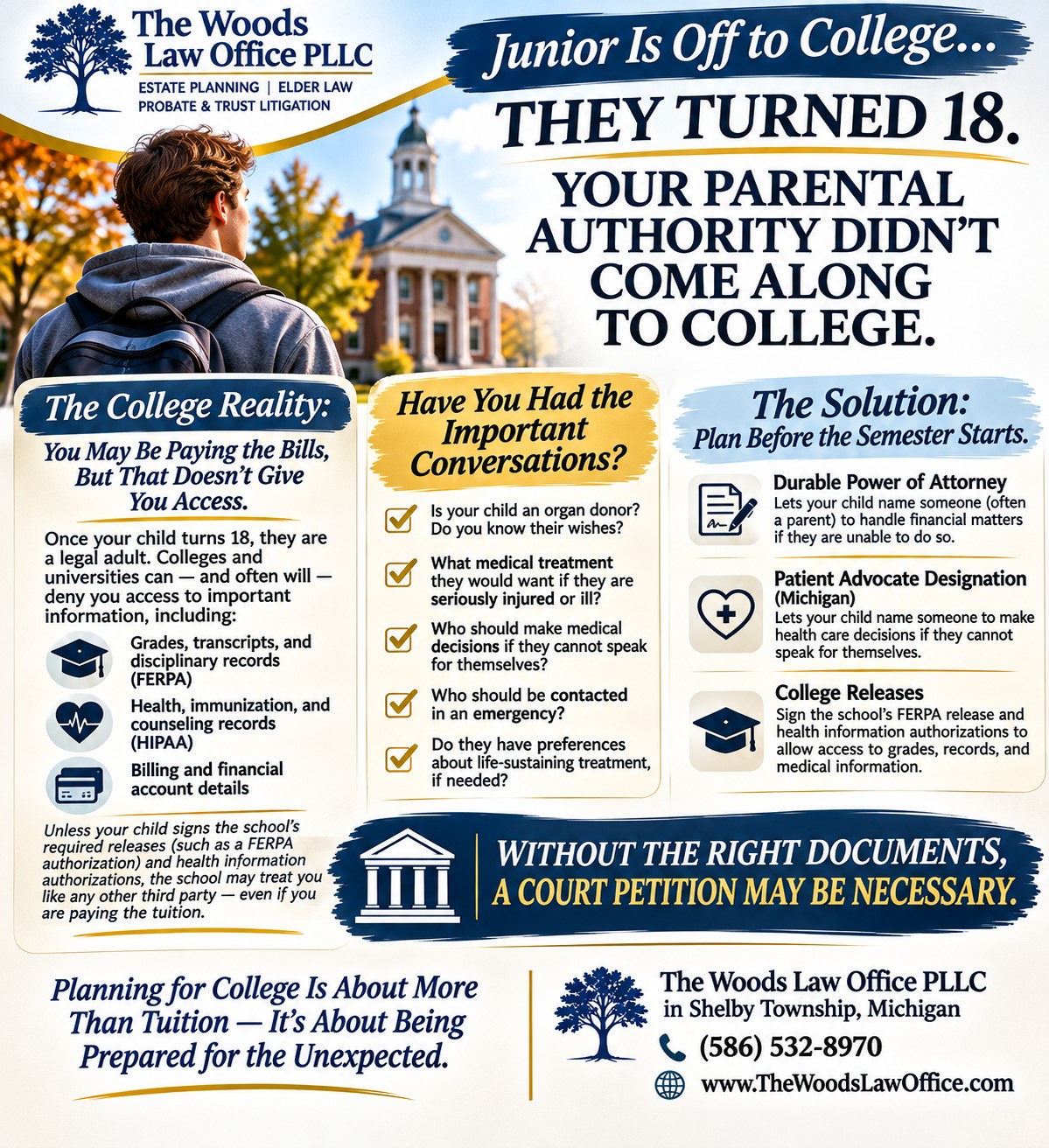
Why Michigan parents should consider powers of attorney, medical decision-making documents, and college information releases before their child leaves for school.
Sending a child off to college is an exciting milestone. Between choosing classes, moving into a dorm, purchasing textbooks, and preparing for campus life, families have plenty to think about.
But there’s one important detail that often gets overlooked.
When your child turns 18, they become a legal adult. And that changes what parents can access and the decisions they can make on their child’s behalf.
Even if you’re paying the tuition, covering health insurance, and helping with living expenses, you may no longer have the legal authority to access certain records or make important decisions for your college student.
At The Woods Law Office PLLC, we encourage Michigan families to consider these issues before the semester begins.
The College Reality: Paying the Bills Doesn’t Automatically Give You Access
Many parents assume that because they are financially supporting their college student, they can continue to access academic records, speak with medical providers, and handle financial matters as they did before their child turned 18.
Unfortunately, that’s not necessarily the case.
Once your child reaches adulthood, colleges, universities, healthcare providers, and financial institutions may restrict access to information that parents previously received.
Some of the most important areas include:
Academic Records and FERPA
The Family Educational Rights and Privacy Act (FERPA) protects the privacy of student education records.
At the college level, FERPA rights generally transfer to the student, regardless of whether the student is still financially dependent on their parents.
This means parents may not automatically have access to:
- College grades and transcripts
- Academic progress reports
- Certain disciplinary records
- Other protected educational information
Although FERPA provides exceptions that may permit disclosure in certain circumstances, colleges frequently require students to complete authorization forms before sharing information with parents.
Being the person who pays the tuition does not automatically guarantee access to academic records.
Medical Information and HIPAA
Another concern involves healthcare information.
Once your child turns 18, healthcare providers generally must respect their privacy rights under the Health Insurance Portability and Accountability Act (HIPAA).
Depending on the circumstances, parents may not automatically receive information about:
- Medical diagnoses and treatment
- Hospitalizations
- Immunization records
- Counseling and mental health services
- Other protected medical information
Imagine receiving a call that your college student has been hospitalized after an accident. Naturally, you want to speak with the doctors and understand what’s happening.
Without appropriate authorization or legal documentation, access to information and participation in medical decisions may be limited.
HIPAA does permit certain disclosures to family members in appropriate circumstances, particularly when the patient agrees or is incapacitated. However, those exceptions are not a substitute for planning ahead.
Financial and Billing Information
Parents may also encounter restrictions when attempting to access financial accounts or handle transactions for their adult children.
Financial institutions generally require appropriate account access or legal authorization before allowing another person to act on an adult account holder’s behalf.
This can become particularly important if a student is studying out of state, traveling abroad, or temporarily unable to manage financial responsibilities.
Five Important Conversations to Have Before College
Preparing your child for adulthood involves more than packing their belongings and reviewing their class schedule.
It also means discussing difficult situations that everyone hopes will never happen.
Before your child leaves for school, consider having these five conversations.
1. Is your child an organ donor?
Does your child wish to be an organ donor? Have they documented their preferences, and does the family understand their wishes?
2. What medical treatment would they want in a serious emergency?
Discuss their preferences regarding medical care if they experience a serious illness or injury.
3. Who should make medical decisions if they cannot speak for themselves?
Your child should understand that their parents are not necessarily automatically authorized to make healthcare decisions once they reach adulthood.
4. Who should be contacted in an emergency?
Make sure emergency contact information is current and accessible, including when your student is away from home.
5. What are their wishes regarding life-sustaining treatment?
Although this may be an uncomfortable conversation, understanding your child’s preferences can provide valuable guidance if a medical crisis occurs.
These conversations help young adults understand their responsibilities while giving families an opportunity to plan together.
Three Important Legal and Administrative Documents for College Students
Fortunately, families can take proactive steps to prepare for unexpected situations.
Depending on the student’s needs and circumstances, three types of documents may be particularly useful.
1. Durable Power of Attorney
A durable power of attorney allows an adult child to appoint someone—often a parent—to handle certain financial or legal matters on their behalf.
Depending on the authority granted, this document may allow the designated person to assist with financial accounts, payments, paperwork, and other transactions if the student cannot manage those responsibilities.
The scope of the authority depends on the document’s terms.
A properly prepared durable power of attorney can be particularly valuable when a student is unavailable, seriously ill, or otherwise unable to handle important financial matters.
2. Patient Advocate Designation in Michigan
Michigan law allows an adult to execute a Patient Advocate Designation, naming someone to make certain healthcare decisions if the individual becomes unable to participate in those decisions.
For college students, this may mean designating a parent or another trusted adult to act as their patient advocate.
The designation must satisfy applicable Michigan legal requirements, and the patient advocate’s authority becomes effective under the circumstances specified by law.
This document can help clarify who has the authority to make healthcare decisions if a serious medical situation arises.
It is also important to understand that a Patient Advocate Designation and an authorization to disclose medical information serve different purposes. Families may wish to discuss whether additional healthcare information releases would be appropriate.
3. College FERPA and Healthcare Information Releases
Colleges and universities typically have their own procedures for allowing students to authorize disclosure of educational records.
Students may need to complete a FERPA release through their school’s student portal or registrar’s office.
Similarly, healthcare providers may have specific authorization forms that allow designated individuals to receive protected medical information.
These releases can help parents stay informed when their adult child wants them involved.
However, each institution may have different requirements, so students and parents should review the applicable forms before the school year begins.
What Happens If Your College Student Has an Emergency Without These Documents?
Most families never expect to face a medical or financial emergency involving their college student.
But accidents, illnesses, and other unexpected situations can occur.
If an adult child becomes incapacitated and has not established appropriate decision-making documents, parents may encounter difficulties obtaining information, managing finances, or making certain healthcare decisions.
In some situations, a court proceeding may become necessary to establish legal authority.
That process can involve additional time, expense, and stress during an already difficult period.
Planning ahead can help families avoid uncertainty when immediate decisions are needed.
College Planning Is About More Than Tuition
Parents spend years preparing their children for college.
They help with applications, financial aid, housing arrangements, transportation, and countless other details.
But preparing a young adult for independence should also include a conversation about legal documents and emergency planning.
A durable power of attorney, Michigan Patient Advocate Designation, and appropriate college information releases can help clarify responsibilities and provide a plan for unexpected circumstances.
Just as importantly, these steps allow your adult child to decide who they trust to assist them.
Help Your College Student Prepare for the Unexpected
Whether your child is entering college for the first time or already attending a university, turning 18 is an important time to review legal planning needs.
At The Woods Law Office PLLC, we help Michigan families prepare for life’s transitions through estate planning, powers of attorney, and related legal services.
Our office can help you understand which documents may be appropriate for your adult child and how they work under Michigan law.
The Woods Law Office PLLC
Shelby Township, Michigan
Phone: (586) 532-8970
Website: www.TheWoodsLawOffice.com
This article provides general educational information and does not constitute legal advice. Legal requirements and institutional policies may vary. Families should consult a qualified Michigan attorney regarding their individual circumstances.