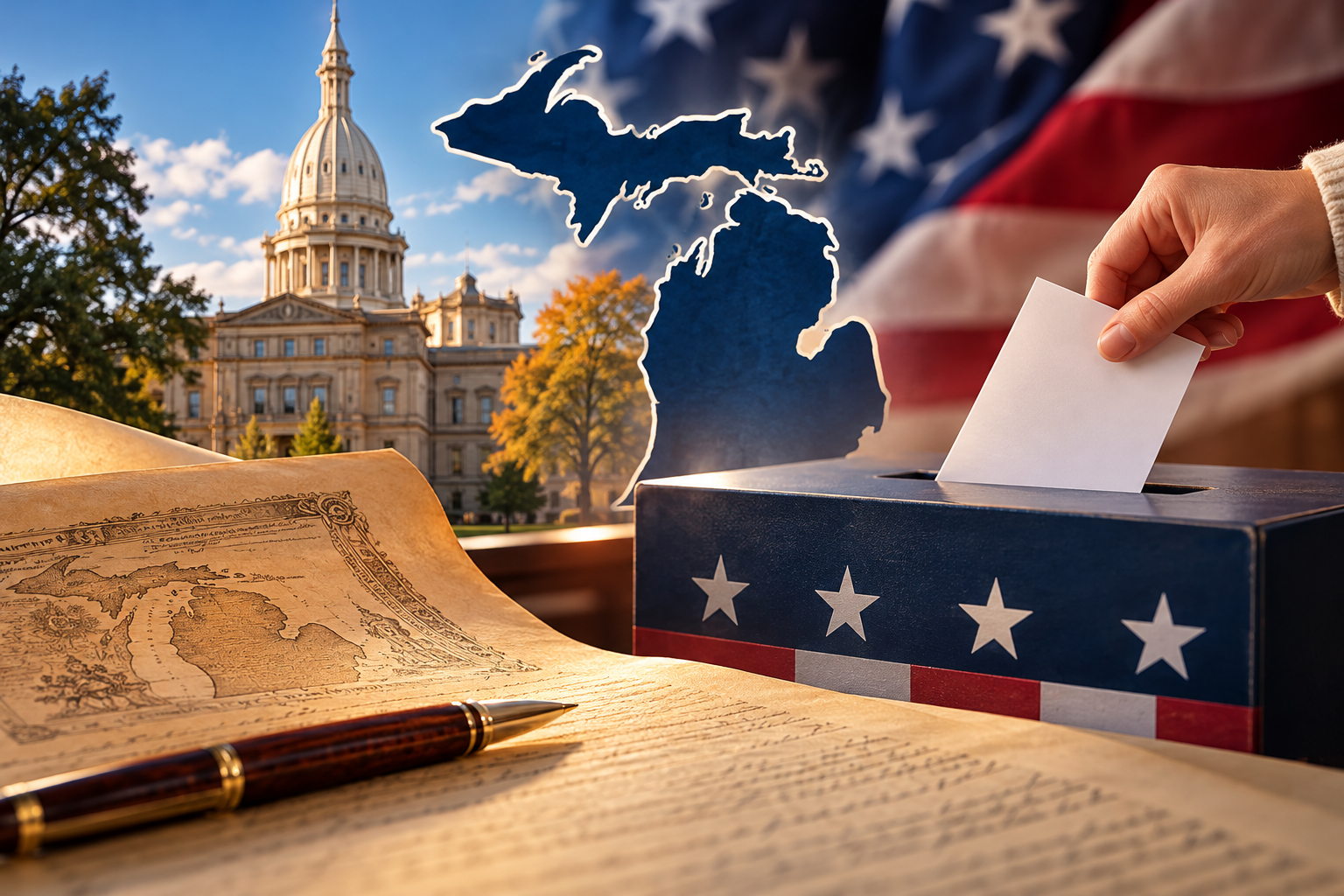
Michigan voters will face an unusual question on the November 2026 ballot: Should Michigan call a convention to revise its Constitution?
This question appears automatically every 16 years under the Michigan Constitution. It is not a proposal to change one particular law or constitutional provision. Instead, voters are being asked whether Michigan should convene a constitutional convention, commonly called a “Con-Con”, to consider revisions to the state’s governing document.
What Would a “Yes” Vote Do?
A “yes” vote would not immediately change the Michigan Constitution.
Instead, Michigan would elect delegates to a constitutional convention. Those delegates could consider proposed changes to the Constitution, potentially involving subjects such as taxation, local government authority, education, elections, the judiciary, governmental powers, and individual constitutional protections. Any proposed revised constitution would ultimately have to be submitted to Michigan voters for approval.
Why Are Some People Supporting It?
Supporters argue that Michigan’s current Constitution dates to 1963 and that the state has changed considerably over the past six decades. They see a convention as an opportunity to modernize state government, reconsider taxation and local-government authority, improve transparency, and address issues that did not exist when the current Constitution was written.
Why Are Others Concerned?
Opponents point out that Michigan already has a process for amending individual portions of the Constitution without opening the entire document.
Their concern is that a constitutional convention would not necessarily be limited to one or two subjects. Once convened, delegates could consider changes throughout the Constitution. A convention would also require delegate elections, public funding, months of proceedings, and ultimately another statewide vote.
Why This Matters
Most ballot proposals ask voters to decide a particular policy question. This one is different.
The November question is essentially whether Michigan should begin a process that could result in a broad reconsideration of the state’s Constitution. A “yes” vote does not approve any particular constitutional change, and a “no” vote does not prevent Michigan voters from considering individual constitutional amendments in the future.
Regardless of your position, this is a ballot proposal worth understanding before Election Day. Michigan’s Constitution establishes the basic framework for our state government and protects rights that affect Michigan residents, families, businesses, and communities every day.
The Woods Law Office PLLC—-This article is provided for general educational purposes and is not intended as legal advice or an endorsement of any position on the ballot proposal.